

Definition:
A workflow process is a defined series of steps that organizes how work, information, and decisions move through an organization. Workflow processes help teams complete tasks more efficiently, improve collaboration, and support workflow automation.
Quick Fact:
Workflow processes help organizations move work from start to finish in a consistent, repeatable way, improving efficiency, collaboration, and accountability across teams.
Key takeaways
- Workflow processes help organizations standardize tasks, improve efficiency, and reduceunnecessary delays.
- Clearly defined roles and responsibilities support better collaboration and accountability.
- Workflow automation can reduce manual work, minimize errors, and improve productivity.
- Effective workflows ensure information reaches the right people at the right time.
- Regular reviews and continuous improvement help workflows stay aligned with business needs.
What are workflow processes?
In today’s fast-paced business environment, understanding workflow processes is key to improving efficiency and productivity. Think of workflow processes as structured paths that guide tasks, information, and decisions through an organization. They help ensure work moves forward in a
logical and consistent way while reducing redundancies and unnecessary delays.
By implementing effective workflow processes, organizations can improve communication, strengthen collaboration, and create more predictable outcomes. This article explores workflow processes, their components, common types, benefits, challenges, and best practices for designing effective
workflows.
Definition of workflow processes
Workflow processes are the series of steps an organization follows to move work from start to finish. They bring together people, tasks, information, and resources to help ensure work is completed efficiently and consistently. At their core, workflow processes are designed to help teams work smarter, reduce inefficiencies, and keep operations running smoothly.
Most workflow processes include clearly defined tasks, assigned roles and responsibilities, and established communication methods. Depending on the organization’s needs, workflows can follow a fixed sequence or adapt as conditions change. Many businesses also use workflow tools and technologies to automate repetitive tasks, track progress, and manage information more effectively.
When designed well, workflow processes can have a major impact on how efficiently an organization operates. They help reduce errors, improve accountability, and make it easier to identify bottlenecks before they become larger issues. Effective workflows also support better collaboration across departments and help teams stay aligned around shared goals. In a rapidly changing business environment, continually improving workflows can provide a meaningful competitive advantage.
Components of workflow processes
To build effective workflows, it’s important to understand the key components that keep them running smoothly. One of the most important is clearly defined roles and responsibilities. When people understand what they’re responsible for and how their work contributes to the larger process, accountability improves, and work moves more efficiently. Roles may include process owners, stakeholders, reviewers, and team members responsible for completing tasks at different stages.
Technology also plays a critical role in workflow management. Modern workflow solutions help organizations automate processes, track progress, and improve communication. Features like process mapping, automated notifications, and reporting capabilities make it easier to manage workflows and identify opportunities for improvement. By reducing manual effort, teams can focus more time on strategic work.
Just as important is how information moves through the process. Effective workflows ensure the right information reaches the right people at the right time. This requires clearly defined inputs, outputs, and communication channels throughout the workflow. Strong information flow supports better decision-making, reduces delays, and helps eliminate data silos that can slow operations.

Types of workflow processes
Understanding the different types of workflow processes can help organizations choose the right approach for their needs. One of the primary distinctions is between sequential and parallel workflows.
In a sequential workflow, tasks are completed in a specific order. Each step must be finished before the next one can begin. This approach is ideal for processes that require strict controls or formal approvals, such as document reviews or compliance procedures.
Parallel workflows allow multiple tasks to take place simultaneously. Because activities can occur at the same time, organizations can often complete work more quickly. This approach is particularly useful for complex projects where different teams can work independently toward a shared goal.
Another important distinction is between manual and automated workflows. Manual workflows rely on human intervention at various stages, which can increase processing time and create opportunities for errors. Automated workflows use software tools to streamline tasks, improve consistency, and reduce administrative effort. Automation helps teams spend less time on repetitive activities and more time on higher-value work.
Consider a marketing department as an example. A sequential workflow might require campaign concepts, designs, and approvals to be completed one step at a time. In a parallel workflow, content creation, social media planning, and analytics preparation could happen simultaneously. Automated tools can further improve efficiency by scheduling posts, tracking performance, and managing approvals automatically.
Benefits of workflow processes
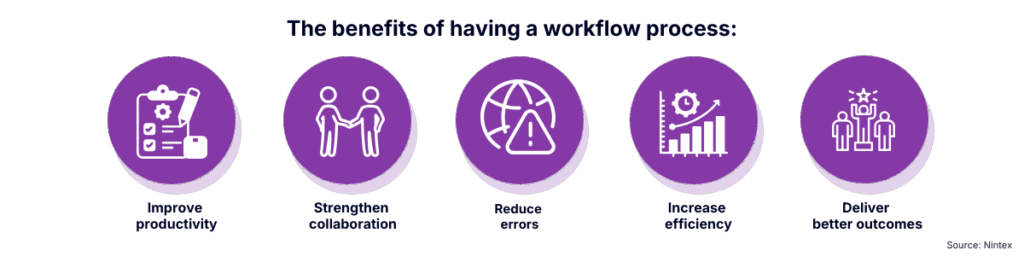
Workflow processes play an important role in helping organizations operate more efficiently and effectively. One of the biggest benefits is improved productivity. By standardizing tasks and automating repetitive activities, employees can spend less time on manual work and focus more on
strategic initiatives. This often leads to faster project completion and better use of organizational resources.
Workflow processes also improve collaboration and communication. Clearly defined responsibilities help create accountability while ensuring team members understand how their work contributes to broader objectives. Many workflow platforms include built-in collaboration features that make it easier to share information, coordinate activities, and keep projects moving forward.
Another significant benefit is reducing errors and creating more consistent outcomes. Automated workflows can incorporate approvals, validations, and other controls that help prevent mistakes before they happen. As a result, organizations often experience smoother operations, stronger compliance, and higher-quality results.
Challenges in workflow processes
While workflow processes offer significant benefits, organizations may face challenges when implementing or improving them. Common obstacles include inadequate planning, lack of employee engagement, insufficient technology integration, and resistance to change.
Many workflow initiatives struggle because processes are not fully aligned with business goals or because employees are not included early enough in the planning process. Legacy systems and disconnected technologies can also create barriers by making information difficult to share across teams and departments.
Resistance to change is another common challenge. Employees may be hesitant to adopt new workflows due to concerns about changing responsibilities or unfamiliar technologies. Organizations can help overcome these concerns by promoting open communication, involving employees throughout implementation, and clearly explaining the benefits of new processes.
Addressing workflow challenges requires thoughtful planning and continuous improvement. Assessing current workflows, identifying bottlenecks, and investing in employee training can help organizations create smoother transitions and stronger adoption. Workflow automation tools can further improve efficiency by reducing manual effort, improving collaboration, and supporting more consistent execution.

Best practices for designing workflow processes
Creating effective workflow processes starts with clearly defining goals and identifying the tasks required to achieve them. Gathering input from stakeholders helps ensure the workflow reflects real business needs and supports desired outcomes. Once requirements are understood, organizations can outline task sequences and assign responsibilities to reduce confusion and improve accountability.
Documentation and process mapping are also essential. Visual workflow diagrams help teams understand how work moves through a process while making it easier to identify bottlenecks, inefficiencies, and opportunities for improvement. Well-maintained documentation also serves as a valuable resource for training and onboarding.
The most effective workflows aren’t static. They evolve as business needs change. Regular employee feedback can uncover opportunities to improve workflow performance and the user experience. Periodic reviews help ensure workflows remain aligned with changing business objectives, technologies, and customer expectations. By continually refining processes, organizations can stay efficient, agile, and better prepared for future growth.
Common workflow challenges and solutions
| Problems | Solutions |
|---|---|
| Inadequate planning | Conduct thorough assessments |
| Lack of employee engagement | Implement training programs |
| Insufficient technology integration | Use advanced automation tools |
| Resistance to change | Foster an open communication culture |
FAQ
What is the purpose of workflow processes?
Workflow processes help streamline operations, reduce redundancies, and ensure tasks follow a
logical sequence, improving organizational efficiency and productivity.
How do workflow processes enhance collaboration?
By clearly defining roles and responsibilities, workflow processes improve accountability and
teamwork. Modern workflow tools also support real-time communication and information sharing.
What challenges are associated with implementing workflow processes?
Common challenges include inadequate planning, lack of employee engagement, insufficient technology
integration, and resistance to change.
How can technology help in workflow processes?
Technology, including Nintex workflow automation tools, can streamline tasks, reduce errors,
improve communication, and make workflows more efficient and easier to manage.