

Quick fact:
Automating customer compliance processes helps organizations reduce manual work, improve accuracy, strengthen audit readiness, and respond more quickly to changing regulatory requirements.
Definition:
Customer compliance automation is the practice of using technology to automate compliance workflows, documentation, monitoring, reporting, and regulatory processes to improve efficiency, accuracy, and risk management.
Key takeaways
- Automating compliance processes helps reduce manual work, errors, and regulatory risk.
- Standardized workflows make it easier to stay consistent, organized, and audit-ready.
- Real-time visibility helps teams identify and address compliance issues faster.
- Automation can help organizations keep pace with changing regulations and growing compliance demands.
Why automate your customer compliance process?
Keeping up with customer compliance requirements can be challenging, especially as regulations become more complex and expectations continue to evolve. Manual compliance processes are often time-consuming, error-prone, and difficult to manage. By automating your customer compliance process, organizations can improve efficiency, reduce risk, and increase accuracy across compliance activities.
Automation helps streamline workflows and support consistent adherence to compliance standards.
The benefits of automating customer compliance
Automating your customer compliance process offers several advantages that can improve day-to-day operations. Automation reduces the time and effort needed to meet regulatory requirements, allowing teams to focus on more strategic initiatives.
Manual compliance processes are often prone to human error, which can lead to costly violations, reputational damage, and unnecessary risk. They can also be slow and difficult to manage, making it harder to keep pace with changing regulations.
Automation improves accuracy and efficiency by standardizing workflows and ensuring consistent documentation and reporting. Real-time monitoring of compliance activities provides timely insights and enables teams to respond more quickly when issues arise. This proactive approach reduces risk, strengthens compliance efforts, and helps build trust with customers and stakeholders.

How to automate your customer compliance process
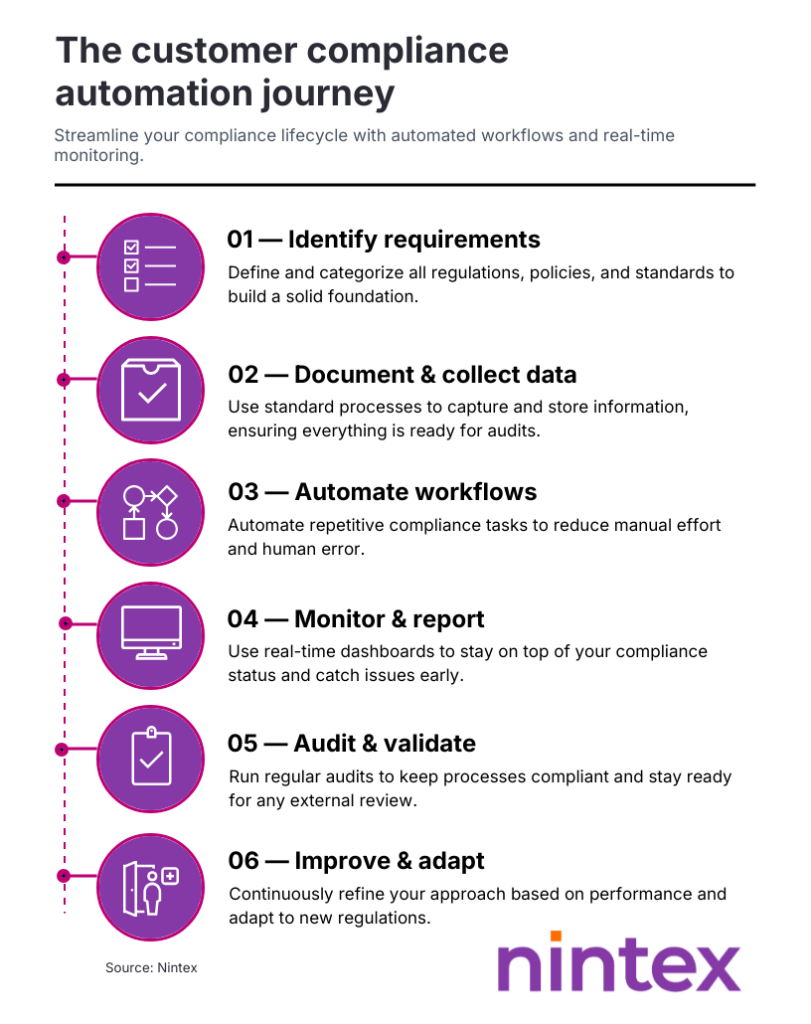
To automate your customer compliance process, begin by selecting the right automation solution. Choose a platform that integrates seamlessly with your existing systems and can scale as your organization grows. The right compliance automation software should provide the flexibility and functionality needed to streamline compliance tasks and support future requirements.
Next, identify the key compliance requirements specific to your industry. This includes understanding regulations, standards, and internal policies. Conduct a thorough assessment to map out what compliance means for your organization and identify areas where automation can have the greatest impact. This clarity will help you build workflows that effectively address each requirement.
Once you’ve identified your compliance needs, implement automation workflows. With powerful automation capabilities, you can create customized workflows that simplify complex compliance procedures. These workflows may include automated alerts for deadlines, documentation management, and data collection, helping ensure compliance activities are tracked and managed efficiently. Automating these processes reduces the risk of human error and improves visibility across your organization.
Best practices for customer compliance automation
Prioritize data security and privacy
Protecting sensitive customer information should remain a core component of any compliance automation strategy. Organizations should use secure cloud services, robust encryption protocols, and strong access controls to reduce the risk of unauthorized access or data breaches. Ongoing employee training can further strengthen data protection efforts and promote a culture of security.
Stay current with regulatory requirements
Compliance requirements are constantly evolving. Organizations should regularly review applicable regulations, industry standards, and internal policies to ensure automated workflows remain aligned with current expectations. Automation platforms that support regulatory updates can make it easier to adapt processes and reduce the risk of noncompliance.
Monitor performance and audit regularly
Effective compliance automation requires ongoing oversight. Establishing key performance indicators (KPIs) can help measure workflow effectiveness and identify opportunities for improvement. Regular audits provide additional visibility into potential compliance gaps while ensuring processes continue to meet organizational and regulatory requirements.
By focusing on these best practices, organizations can create a stronger foundation for compliance automation while increasing trust among customers, partners, and stakeholders.
Customer compliance automation in practice
Organizations are increasingly turning to compliance automation to streamline processes and reduce risks. For example, a leading financial institution successfully used automated compliance software to overhaul its compliance workflows. By digitizing and automating documentation processes, the organization accelerated approvals and strengthened adherence to stringent regulatory requirements.
The financial institution reported a 40% reduction in compliance-related errors and a 30% increase in the speed of processing compliance documentation. These improvements enhanced operational efficiency while strengthening overall risk management capabilities.
These successful implementations demonstrate the importance of thorough planning and stakeholder engagement. Organizations should begin with a clear understanding of their regulatory landscape, assess existing processes, involve key stakeholders early, and continuously refine workflows as requirements evolve.
By embracing customer compliance process automation, organizations can meet compliance requirements more effectively and position themselves for sustainable growth in a competitive market.
The future of customer compliance automation
The landscape of customer compliance process automation is rapidly evolving as emerging technologies continue to reshape compliance management. Advanced software solutions enable organizations to automate manual tasks, reduce the risk of human error, and improve operational efficiency.
One significant development is the integration of artificial intelligence (AI) and machine learning (ML). These technologies enable compliance teams to analyze large volumes of data, identify patterns, and uncover potential compliance risks more quickly than traditional methods. By automating routine compliance checks and providing AI-driven insights, organizations can devote more resources to strategic initiatives while strengthening their compliance posture.
Predictive analytics is also playing an increasingly important role in proactive compliance management. By analyzing historical data and current trends, organizations can anticipate compliance challenges before they arise. This approach supports better decision-making, improves risk management, and helps businesses adapt more quickly to regulatory changes.
As organizations continue adopting these technologies, compliance automation is becoming more intelligent, proactive, and efficient. The result is a stronger compliance program that not only reduces risk but also creates measurable business value.
Common problems and solutions in customer compliance process automation
| Problems | Solutions |
|---|---|
| Human error in manual processes | Standardizing workflows through automation |
| Time-consuming and slow workflows | Accelerating processes with automated tasks |
| Difficulty in keeping up with regulatory changes | Integrating regulatory updates into workflows |
| Lack of real-time monitoring and insights | Implementing real-time monitoring systems |
| Risk of compliance violations and penalties | Ensuring consistent adherence to compliance standards |
FAQ
What is customer compliance process automation?
Customer compliance process automation refers to the use of technology to streamline and manage compliance activities, helping organizations meet regulatory requirements more efficiently and accurately. Automation reduces manual effort while improving consistency, visibility, and accountability across compliance processes.
What are the benefits of automating compliance processes?
Automating compliance processes helps reduce errors, save time, improve accuracy, and support consistent adherence to regulatory standards. It also provides better visibility into compliance activities, enabling organizations to identify and address potential issues more quickly.
How do I choose the right automation solution?
Look for a solution that integrates with your existing systems, can scale with your organization, and provides the flexibility needed to address your specific compliance requirements. The right platform should simplify compliance management today while supporting future growth and regulatory changes.
What are the best practices for implementing compliance automation?
Successful compliance automation starts with strong data security, ongoing awareness of regulatory changes, and regular monitoring of automated processes. Organizations should also establish clear performance metrics and conduct routine audits to ensure workfl ows remain effective and compliant over time.