Skip to content
eBook

Breaking through the automation ceiling

  1. / Home
  2. / Resources
  3. /

ebook

Breaking through the automation ceiling

AI-driven orchestration unlocks what automation alone can’t 

Including insights from NintexConnect 2026, featuring Forrester VP & Principal Analyst Craig Le Clair and Nintex customers GM Financial and Hawaii Employers Mutual Insurance Company.

Welcome to the automation inflection point 

For decades, automation meant doing the same things you were already doing, only faster. Forms went digital, manual handoffs got eliminated, and systems that had never spoken to each other could be seamlessly connected. That meant increased efficiency, decreased risk of error, and an overall better experience across a multitude of business processes.

But with the advent of AI, we’re seeing new possibilities. Rather than just continuing to move faster, we can start expanding the boundaries of what automation means and what it can achieve. Processes that once ground to a halt at the words “human intervention required” are now within reach of true, governed autonomy. So why aren’t we doing it already?

The challenge is that with expanded possibility comes expanded complexity. More systems, more agents, more data, and more expectations require more than automation – they require orchestration. And that changes the strategy for every organization investing in process improvement. Organizations trying to simply layer AI onto fragmented tools aren’t really transforming … they’re just buying into hype.

The organizations that will succeed in this new era aren’t those who just automate more, but those who orchestrate differently, connecting agents, people, processes, and systems into coordinated, intelligent architecture.

About this guide

This guide draws on conversations from NintexConnect 2026 — with Forrester VP and Principal Analyst Craig Le Clair, and with operational leaders from GM Financial, LA County’s Department of Health Services, and Hawaii Employers Mutual Insurance Company — to offer a practical, grounded view of how to embrace the new wave of automation and how to navigate your journey toward AI-driven orchestration.

“The initial results over the last six months have not been so good. They haven't really captured enough business value for the C-suite to be thrilled with the progress. They're certainly seeing the costs and the investment, but they're not seeing the returns yet.” CRAIG LE CLAIR, VP & PRINCIPAL ANALYST, FORRESTER

AI adoption status: Where are organizations today, really?

Even among the most automated organizations, there is a gap between where people think they are on their digital transformation journeys and where they really are. Understanding that gap, and how agentic AI will continue to widen it, is the first step toward closing it.

Craig Le Clair, VP and Principal Analyst at Forrester and one of the leading researchers covering the agentic orchestration space, paints a nuanced picture: Based on recent survey data, approximately 15% of organizations are seeing genuine productivity from AI agents in production. Around 40% have undertaken promising pilots that are doing interesting things — but they are not comfortable moving them to production. Another 15% are not doing anything at all, waiting to see how things develop.

That leaves the majority of organizations in “pilot purgatory,” or what Le Clair calls “proof of concept purgatory”: good intentions, significant investment, and results that have not yet translated into business value.

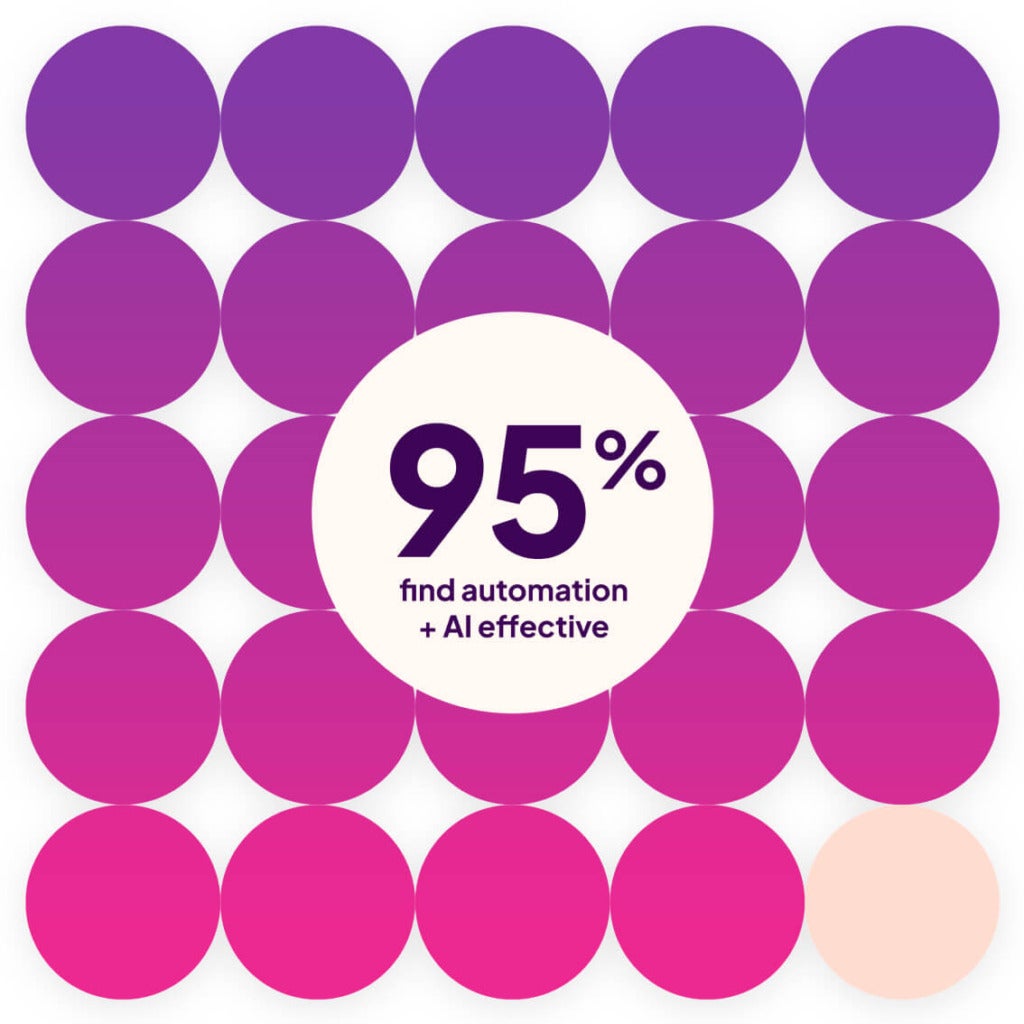
Infographic: Our recent survey reports that 95% of CIOs and CFOs find the combination of automation + AI effective.

recent Nintex survey narrowed in on the outliers and found that 95% of CIOs and CFOs surveyed say that AI plus automation does effectively deliver on business outcomes. To maximize the value of AI across your organization, achieve measurable business outcomes, scale effectively, and protect your mission-critical operations from risk, it is crucial to begin your AI initiatives with a foundation of automation.

Agentish vs. agentic: A critical distinction 

Let’s pause and consider the distinction between generative AI and agentic AI. While generative AI helps users create (new strategies, text, code, ideas, and more) based on user prompts, agentic AI — ideally — takes action without waiting for prompts. When organizations talk about incorporating AI into their businesses processes, they are generally talking about agentic AI.

But part of what’s keeping organizations stuck in this purgatory stems from how loosely the word “agentic” is being used. Le Clair draws a careful distinction between systems that are truly agentic and those that are what Forrester calls “agentish” — meaningful, but a different category entirely.

Most AI systems in production today are insight agents: Large language models used for search or retrieval-augmented generation (RAG), providing useful outputs but lacking a meaningful action component. Slightly more advanced are solver agents — taking a deterministic process and automating a specific workflow step using a model. Le Clair offers anti-money laundering alert review as an example: A model reviews flagged transactions, filters out roughly half the false positives, and hands off only the genuine alerts to human analysts. Valuable, but “agentish.”

Worker agents go further: The model itself does the orchestration, routing work to pre-built automations, RPA bots, APIs, or human endpoints. Even more transformative, but still technically agentish. (Psst – Nintex Agent Designer falls into this category. Watch it in action!)

Truly agentic systems — what Le Clair calls  executive agents — require three things that do not yet exist in production anywhere:  

1. The ability to create new tools or patterns at runtime that did not previously exist 

2. Advanced collaboration and conflict resolution among multiple sub-agents 

3. Self-optimization based on data within the running process itself 

Le Clair’s is not a pessimistic statement, but a clarifying one. It means organizations that are feeling behind are not actually behind — they are navigating the same frontier as everyone else.

And it means the practical opportunity right now is in worker and solver agents, not executive agents: Getting the “agentish” implementations right, governed well, and built on foundations strong enough to support what comes next.

The future is not about deploying the most or even the best agents. It is about orchestrating them well.

Overcoming the barrier of trust

The single biggest obstacle to moving from purgatory to production isn’t technology, but trust. When Forrester surveys organizations on what concerns them most about agentic AI, the same themes surface consistently:

Explainability

The ability to understand how a decision was made. In an agentic system, decisions are made autonomously, in ways that were not pre-ordained by a designer. For organizations in regulated industries like financial services, healthcare, and insurance, that is not an abstract concern but a compliance requirement.

Data governance and security

Proprietary data being exposed to external models, employees using unsanctioned AI tools, GDPR violations from personal data entering a general-purpose model are real risks when an organization doesn’t have a handle on how its employees are using AI. Le Clair describes model sprawl as a significant and growing risk inside enterprises.

Key Takeaway

The opportunity in AI agents is genuine, but so is the gap between expectation and results. Organizations that approach their AI implementations with honest self-assessment, clear use case selection, and governance built in from the start are the ones converting pilots into production.

The automation foundation: You can't outsource what you don't understand 

The most consistent message from those who are actually getting results from automation and AI is one that rarely features in keynote demos or vendor marketing: It starts with understanding your processes.

Not automating them. Not enhancing them with AI. Just understanding them.

This sounds obvious, but is surprisingly rare. Most organizations carry their process knowledge in the heads of long-tenured employees, in email threads, and in undocumented workarounds that evolved organically over years. When automation projects stall, as many do, it is often not because the technology failed, but because the technology was pointed at a process that nobody had fully mapped.

“You really can’t automate something you don’t understand. Step one is understanding it.” 

—Kevin Schaal, CEO, AiGS (Nintex Premier Partner) 

The GM Financial approach

Larry Bennett leads the process excellence team at GM Financial, where his mandate is deceptively simple: Document how work actually happens across the enterprise, and make that knowledge accessible to everyone who needs it.

It is slow work. There is no enterprise-wide mandate forcing departments to participate. Adoption happens department by department, built on demonstrated value rather than top-down directive. In the early days, the benefits were not immediately obvious and progress was gradual.

But the documentation repository has grown. And as it has, teams that had operated in silos began to see how their work connects to others. Automation opportunities that were invisible when processes were examined individually became apparent when viewed end-to-end. Audit and compliance teams found documented foundations to map controls against. And AI tools, now in the early stages of layering on, have something real and reliable to work with.

The HEMIC experience

Hawaii Employers Mutual Insurance Company (HEMIC) came to Nintex at a different point in their journey — not with a specific broken process to fix, but with a strategic mandate to modernize how work gets done across the organization. Chief Transformation Officer Leila Kagawa describes the challenge facing many mid-sized organizations: The market for automation and AI tools is overwhelming, and the pressure to move quickly can lead organizations toward the wrong solutions.

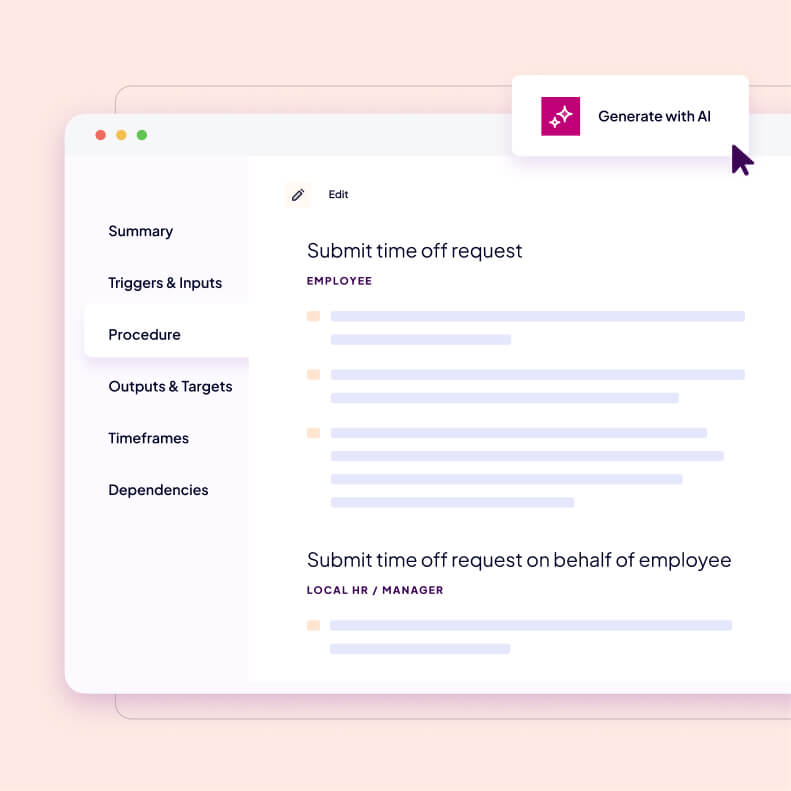
HEMIC’s approach has been deliberately sequenced. Working with Nintex Premier Partner AiGS, they began by documenting standard operating procedures in Nintex Process Manager — establishing a baseline understanding of how work actually flows before attempting to automate or augment it with AI. The goal is not just operational efficiency, but giving people the clarity to focus on what matters most.

“We always talk about technology in terms of meeting people where they are. We had to find a partner that meets us where we are on our continuous improvement journey.” 

— Leila Kagawa, Chief Transformation Officer, HEMIC 

Kagawa is also thinking deliberately about her workforce. HEMIC’s employees span multiple generations, with different relationships to technology. Automation, she believes, can give experienced employees relief from repetitive work — freeing them for the relationship-intensive parts of their jobs — while creating more standardized and navigable onboarding paths for newer team members.

Key Takeaway

The foundation for successful, transformational AI implementation is not glamorous. But it is the difference between automation that scales and automation that stalls. Organizations that invest in understanding their processes before automating them consistently outperform those that skip this step.

Governance is not optional … nor should it be a roadblock

There is a version of the AI conversation that treats governance as a constraint — something that slows down innovation, that cautious legal and compliance teams impose on enthusiastic technology leaders. We think that framing gets it backwards.

Governance is not the roadblock to AI adoption. It is the thing that makes AI adoption sustainable. 

This is one of the clearest takeaways from Le Clair’s analysis of where organizations are struggling. The AI deployments that have failed to deliver value share a pattern: They moved fast, they skipped the control layer, and they produced outputs that their organizations as a whole were not comfortable enough in to act on.

“You need auditability. You need explainability. You need a level of observability. All of that is independent of how the agents are interacting with each other — but you need to understand those things.” 

— Craig Le Clair, VP & Principal Analyst, Forrester 


What good governance looks like

Le Clair describes an architectural model with three planes:

1. Orchestration plane

An orchestration plane that manages how agents and workflows interact

2. Control plane

A control plane that handles explainability, auditability, observability, data governance, and guardrails (as an adaptive process orchestration provider, Nintex offers a control plane for agentic systems within its deterministic automation suite)

3. Build plane

A build plane that forms the development environment for creating agents and agentic systems

The Control Plane

That control plane is not a single tool but a set of capabilities that organizations need to have in place before they can trust the outputs of autonomous systems enough to act on them. Those capabilities include:

Explainability

The ability to understand how and why a decision was made, traceable through the running process 

Observability

Monitoring of latency, autonomy level, conflict resolution, and other metrics that traditional process monitoring never needed to track 

Data governance

Control over which agents access which data, preventing proprietary information from entering unsanctioned models or leaking through external APIs 

Guardrails

Defined boundaries within which agents operate, with human escalation paths when those boundaries are approached

“We were looking for the right AI tools that fit us where we are now. You have to find a partner that meets you where you are — not just bring something standard and apply it across the board.” LEILA KAGAWA, CHIEF TRANSFORMATION OFFICER, HEMIC

Governance as a competitive advantage

Schaal makes a related point from a different perspective. He sees the market shifting away from the early urgency to “automate everything” and toward a more intentional stance: Organizations now see the need for checks and balances, improved accuracy, and reduced hallucinations, especially in industries where the cost of a wrong answer is high.

That means they’re more likely to prioritize building governance into their automation architecture from the start. Crucially, they are not moving slower than their competitors. They’re actually building the trust infrastructure that allows them to move faster over time. Every AI deployment decision they make is one they can stand behind, explain to auditors, and build upon.

The ones that skip governance are building on sand. Often, their first production failures aren’t learning experiences but setback that can affect their AI strategies for years.

At HEMIC, Kagawa frames it in terms of what the organization is trying to accomplish: Not to deploy AI for its own sake, but to solve specific problems in ways that can be explained, measured, and trusted by the people whose work depends on them.

Key Takeaway

Governance is not a constraint on AI adoption but the foundation that makes AI adoption trustworthy, scalable, and sustainable. Organizations that build the control plane first will outperform those that skip it entirely or try to bolt it on later.

Orchestration is the new competitive advantage

Prediction: The next phase of AI and automation investment won’t be defined by how many agents an organization deploys but by how well those agents are orchestrated alongside people, workflows, and systems to drive measurable outcomes.

That is both a technology challenge and a strategic one … one that Le Clair has thought carefully about.

From deterministic to adaptive

Forrester has introduced the concept of Adaptive Process Orchestration (APO) to describe where the market is heading. At Nintex, we call it Agentic Business Orchestration. The underlying insight from both concepts is that the coordination challenges of the near future look fundamentally different from what traditional automation platforms were built to handle and require fundamentally different approaches to undertake.

Where traditional intelligent automation platforms managed APIs, RPA bots, and workflow steps, the emerging challenge involves coordinating all those plus potentially hundreds of agentic AI models with different access requirements, different latency profiles, different governance needs, and the human workers who need control over when and where they step into various processes.

Le Clair describes APO as drawing on capabilities from five existing market categories:  

The organizations (and platforms) that can bring those capabilities together in a coherent orchestration layer will have a significant advantage.

Integration and API management (iPaaS) 

Robotic process automation (RPA) 

Digital process automation 

AI platform capabilities 

Low-code development 

The real transformation

What makes the agentic moment genuinely different from previous waves of automation, Le Clair argues, is not that it allows organizations to do the same things faster, but that it allows them to reimagine the processes themselves.

In the deterministic world, humans served as middleware: The connective tissue between systems, interpreting context and making judgment calls that could not be encoded in rules. AI agents can soon overtake that role, making connections across information domains that no human could efficiently maintain, and routing work to the appropriate next step based on understanding rather than predetermined rules.

That shift does not make humans irrelevant. In fact, it makes human judgment more valuable when applied where it is truly needed rather than consumed by coordination and routing.

The future of orchestration is bright

Le Clair invokes science fiction writer William Gibson, who said, “The future is already here — it’s just not evenly distributed.” Before the mobile explosion, he recalls, the BlackBerry was so popular among a small group of professionals that prescient observers could already see the coming cell phone boom, if not its exact form (the iPhone was introduced in 2007).

Today, he sees the same pattern in AI: Pockets of organizations already using agentic capabilities with remarkable precision and confidence, making decisions in ways that required very little configuration and delivered outsized results.

“You see these little pockets of brilliance, and you think: There are legs here. There are good things coming down the road. But we have to be patient, and we have to solve these trust issues.” 

— Craig Le Clair, VP & Principal Analyst, Forrester

The opportunity is real, but the timeline requires patience. But the organizations that are building their foundations now — documenting their processes, building their AI governance, and sequencing their automation investments deliberately — are the ones who will be best positioned to move when the moment arrives.

Six practical principles of agentic business orchestration 

Getting orchestrated: How to start 

The insights surfaced by Le Clair, Kagawa, and Schaal aren’t revolutionary. They’re … dare we say … kinda boring.  They are, in the best sense, obvious … which is probably why so many organizations think they can skip them. You can’t.  

1. Start with the process, not the technology 

Every expert we talk to says some version of the same thing: You cannot automate what you do not understand. Before selecting tools, before deploying agents, and before writing a single workflow, invest in understanding how work actually gets done in your organization. Document it. Make it visible. Map the connections.

2. Select use cases with discipline

LeClair says the factor most correlated with success in AI agent deployments is selecting the right use case. Run ideation with department leaders and relevant employees. Prioritize problems where the value of solving them is clear, where the process is well enough understood to automate responsibly, and where success will be visible and measurable.

3. Start agentish 

True agentic systems — self-optimizing, conflict-resolving, runtime-creating — do not exist in production yet. The practical opportunity right now is in worker agents and solver agents: automating specific steps, augmenting specific decisions, connecting specific systems. Get the basics right and you’ll build the organizational confidence that lets your adoption mature alongside agentic capability.

Build governance in from the start 

The control plane isn’t something you can add later. Explainability, auditability, data governance, and guardrails need to be architectural decisions made at the beginning, not retrofitted after the first production failure. Organizations that govern well can move fast. Organizations that skip governance cannot move at all.

5. Build an internal adoption capability 

Technology that nobody uses delivers no value. Build an internal advocacy function, whether a formal center of excellence or a small team of dedicated champions, that can demonstrate value, build success stories, and create the momentum for organic adoption. Top-down mandates help, but bottom-up culture helps more.

6. Choose a platform that scales with you 

The organizations doing AI right aren’t adopting it just to keep up with the crowd. They are using it to solve specific problems, in governed ways, on platforms designed to support the entire journey — from process documentation through workflow automation to agentic orchestration. The platform matters. Choose one that won’t make you restart as your capacity and ambitions grow.

Get Started Today

Explore Nintex Agent Designer & Nintex Orchestration 

Nintex has launched two new orchestration capabilities available natively in Nintex CE: Nintex Orchestration, for building complex dynamic workflows broken into manageable phases that can transfer control based on events or runtime data, and Agent Designer, which enables single-agent, multi-agent, and supervisor/sub-agent systems natively on the platform. Together, they enable organizations to blend agentic AI with deterministic process control, with human context and appropriate governance maintained throughout.

Intrigued?

Three professionals in business attire have a discussion around a table. Two women are looking at and interacting with a tablet, while a man listens attentively. The setting appears to be a bright, modern office.

See for yourself

Put Nintex to the test

Because seeing is believing, let us give you a firsthand look at how Nintex can work for you.